Sabrina Carpenter’s Heterofatalist Turn
Sabrina Carpenter has killed another boyfriend.
In the video for her new single “Tears,” Carpenter wakes to the scene of a car crash; her boyfriend’s limp body slumps behind the steering wheel. She goes to a nearby farmhouse for help, only to find an orgiastic, queer fantasy world lead by Coleman Domingo. By the end of the video, her hair is bigger, her clothes are smaller, she’s doing joyful synchronized dances with drag queens and femme dommes. But suddenly she’s back in her skirtsuit and her boyfriend, alive but worse for wear, is stumbling toward her. She rolls her eyes, disappointed to find that he’s survived the crash, and jettisons her stiletto through his chest. As she walks away from his bleeding corpse, she lifts her hands and says, to no one, “We have to give the people what they want.”
And Carpenter is, indeed, giving the people what they want. Dead and dying men have become a signature of her music videos: in “Feather” catcallers get hit by a truck, gym bros beat each other to death, and Carpenter herself beheads a businessman by closing his tie into an elevator door; In “Espresso” a man gets flung off a speedboat and Carpenter uses his credit card to buy beachside luxuries; In “Manchild,” men drive themselves off cliffs. In each music video a man dies, and meanwhile Carpenter twirls and dances in short skirts, singing lyrics like “I like my boys playing hard to get / and I like my men all incompetent” and “heartbreak is one thing / my ego’s another / I beg you, don’t embarrass me / motherfucker.” In Carpenter’s world, men are embarrassing, irredeemable; to desire them is to show weakness; but by no means will she stop dating them. And her audience, primarily young, progressive women, cheer her on as she lives out the fantasy of countless disaffected straight women—wouldn’t it be so nice to just push these men off a cliff?
Carpenter has adopted the feeling of the moment. In 2019, queer theorist Asa Seresin coined this feeling “heteropessimism”—the performative disaffiliation of straight women to their own straightness, marked by a sense of embarrassment, regret, and nihilism about their attraction to men. Also called heterofatalism, this mode of heterosexual womanhood has gained traction in recent years: there’s Blythe Roberson’s self-help-cum-comedy book How to Date Men When You Hate Men, Jean Garnett’s New York Times Magazine piece “The Trouble With Wanting Men.” The Barbie movie is a heterofatalist text, as is Jennifer’s Body. Social media is rife with posts about pathetic, embarrassing men and the embarrassed women who fall for them. The strain of think pieces and films and posts all iterate on women’s disaffection with men and a professed desire to be free of them, and Carpenter’s work fits neatly into the milieux; her new song “Nobody’s Son” has become the background music to TikTok outfit inspo videos captioned, “Get Ready With Me to be disappointed by somebody’s son!” while women swan around in cheeky date night outfits. As Jezebel staff writer and host of the heterofatalist podcast Dire Straights Tracy Clark-Flory writes, “she makes me smile…Carpenter’s lyrics tear men to shreds, but she loves them anyway.”
After all, a requirement of heterofatalism is, alas, heterosexuality. A common critique levelled against heterofatalism is that it’s “performative”—that women will complain about men, but they’ll keep on dating them. Seresin critiques heterofatalism as “anesthetizing,” that it “reinscribes heterosexuality’s tired features.” He’s right that many heterofatalist screeds offer an almost bioessentialist vision of the world where straight men will always inevitably disappoint their partners, leaving little room for hope that women can influence gender politics on a systemic level. In fact, like Sabrina, the best hope a heterofatalist can offer is not an equitable partnership but freedom from men entirely. At the end of her diatribe against the “studiously irreproachable male helplessness” she has encountered on the dating scene, Garnett concludes that maybe, all women can do is wait for a “new way of dating to be born.” Roberson similarly decides that all she can do is “keep trying to get men to kiss [her] while not oppressing [her],” though she predicts it’s more likely she’ll be “forever alone” until she “fall[s] into the Grand Canyon and die[s].” The heterofatalists picture a world where prioritizing oneself means, in all probability, leaving men behind, as Greta Gerwig’s Barbie chooses at the end of the Barbie movie to forsake Ken for the capacity to visit a gynecologist’s office.
At face value, Carpenter is an unlikely posterchild for heterosexual discontent. A former Disney Channel star-turned pop sensation, Carpenter has built a career on campy, sexually explicit, and extremely hetero performances: Her Short N’ Sweet tour featured a retro, pinup vibe, with Carpenter donning vintage lingerie and dancing on giant half-veiled beds to songs about “doing bad things” and “oversized” male anatomy. Her performance of “Juno,” a single off her 2024 album “Short N’ Sweet,” garnered both attention and criticism for its hypersexuality. The song is about desiring a man so much that she wants him to get her pregnant, and involves expressions of desire for “fuzzy pink handcuffs” and “freaky positions,” the latter of which she acts out during live performances—pantomiming a three-person sex act dubbed the “Eiffel Tower” in Paris, the “London Bridge” in London. Her very public relationship in 2023 with actor Barry Keoghan, who had attracted attention for both his performance in “Saltburn” and the film’s display of his own oversized anatomy, solidified Carpenter as, as one X user succinctly put it, “the Most Heterosexual Woman to [Ever] Exist.”
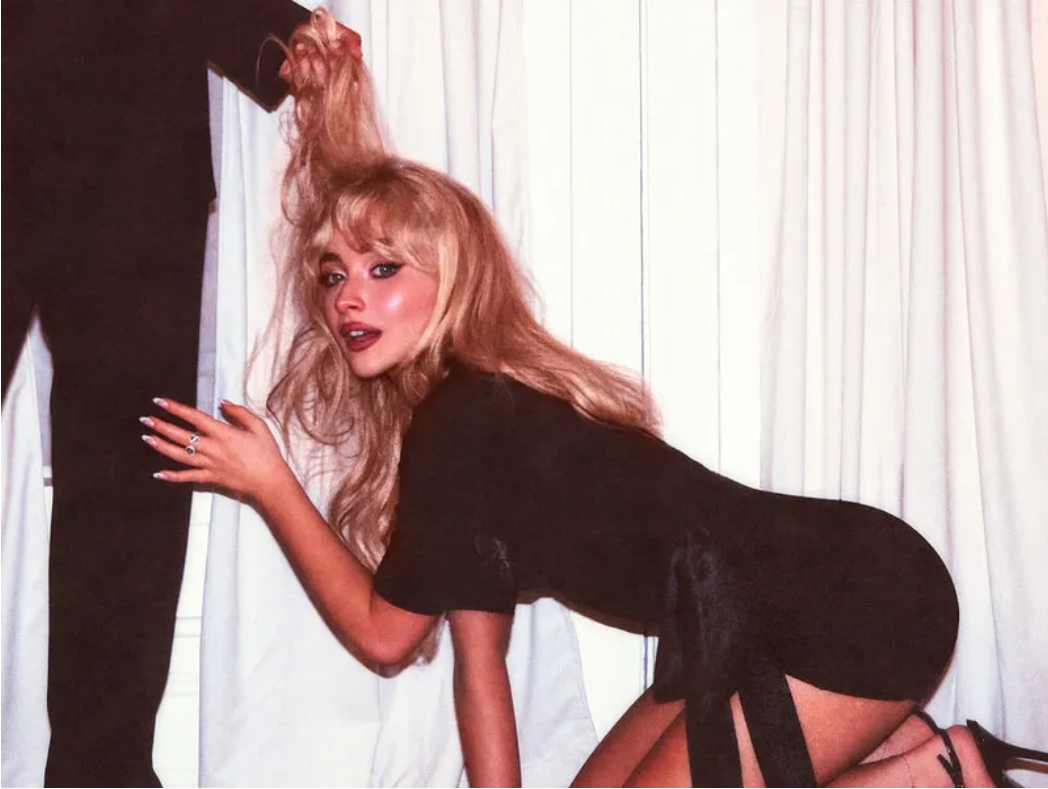
Her work has been criticized over the years as being retrogressive; she often flirts with traditionally objectifying imagery, adopting pin-up style lingerie as tour costumes and writing lyrics joking about the “fortune” she spent on her “wax floors” in a song where a house is a metaphor for her body. In response to her “Eiffel Tower” display, a number of detractors took to X to claim that “all she does is contort herself into degrading sexual poses,” while defenders argued that calling her work misogynistic is akin to slut-shaming and is misogynistic in and of itself. The “is Sabrina a misogynist” discourse exploded once again following the release of her latest album Man’s Best Friend, whose cover features Carpenter, face flushed, on hands and knees while a suited man stands above her holding her by her hair: Is it degrading? Is it sexual expression? Is she perpetuating violence against women, or reclaiming her desire?
But what if the ambiguity is the point? For many heterosexual women, the boundary between eroticism and degradation is blurry at best. Detractors argued that Carpenter’s album cover reinforces sexist tropes; defenders said that she’s “owning and doing what she wants with her body,” a feminist act in and of itself. Both are right, perhaps, and both are wrong. Whether intentional or not on the part of Sabrina—and we have good reason to believe that it’s not, given her response when questioned that her critics should simply “get out more”—the debate about the political impact of her work reveals the difficulty of distinguishing heterosexual desire from debasement. The “Tragedy of Heterosexuality,” as queer theorist Jane Ward coined it in her book of the same name, is that straight culture is a “patriarchal institution that has long benefited men and harmed women.” Decades of research support this claim: women across all class and racial lines, including working women and child-free women, still spend twice as much time on domestic tasks than their male partners, and have 13% less free time; Women who partner with men are more likely to suffer in their career and have unsatisfying sex; unmarried heterosexual women report higher levels of satisfaction and live longer than their married peers, while the inverse is true for straight men. Despite Carpenter’s violent rampages against her various music video boyfriends, according to the CDC the man I love is the person most likely to murder me. And given the right-wing turn of American men, the rollback of Roe v. Wade, the explosion of Tradwives and Divine Femininity hustlers, the ubiquity of violent, debasing pornography, the persistently high rates of rape and sexual harassment; given the decades of Disney movies where princesses gained upward social mobility and economic stability via marriage to a handsome prince, that it’s only been fifty or so years that women have been allowed take out our own credit cards, get a mortgage, only ten years that women have had the right to marry other women, a right that’s being threatened under recent conservative judicial consolidation; given all of this, how is a straight woman supposed to distinguish between authentic desire and participation in her own oppression?
But there’s nothing inevitable about heterosexual conflict. Gender is learned, not inherent, and relative to the vast expansion of women’s liberatory consciousness of the last hundred years, cultural attitudes about and expectations for men have remained remarkably static. While second wave feminism earned women the ability to participate fully as economic equals—women now make up about 50% of the US workforce, and almost 60% of US college graduates—there has not, by and large, been a shift in heterosexual men’s behavior to meet the changing needs of their newly-“liberated” partners. While there’s been an expansion in recent years of media geared toward women and girls that’s about adventure and accomplishment rather than love—young girls are watching Moana and Brave rather than Cinderella—there has not been a similar shift in narratives for boys about partnership and domesticity. Women are now expected, in media, to both slay the dragon and play house, to self-actualize and win the man. Men and boys, meanwhile, can continue to fantasize about football stardom and WWI trench warfare while their mother or girlfriend or wife cooks dinner and makes the bed.
If heteropessimism is the result of an uneven application of feminism—women have evolved, and men haven’t—then perhaps the solution is not to wait patiently but to apply pressure on men to change their behavior. There’s a difference between disaffection and nihilism; the cycle of heterosexual disappointment relies, after all, on a woman’s hope that “this one will be different;” that men are capable of growth, that men are just as socially constituted as women are, that if we point out how men are failing us, refuse the blind acceptance of men’s incompetence by making memes and art and music videos, men might hear and care and change. Unlike the brooding antiheroes of Lana del Rey or the negligent boyfriends of Taylor Swift, both of whom are painted as capable, autonomous, cowboy-like figures who just don’t care enough to treat a woman right, Carpenter’s depiction of men as stupid and clueless might be a more appropriate mode of resistance. After all, as the saying goes, while a woman’s worst fear is a man will kill her, a man’s worst fear is that a woman will laugh at him.
Heterosexual womanhood is rife with cognitive dissonance: is my desire genuine, or an extension of patriarchal control? Do I want to wear this dress for me, or for an internalized male gaze? What does it mean to want to do something for me, at all? If everything a woman does is subject, at least in part, to male desire, so much so that an album cover can be interpreted as a valid expression of female agency or as pandering to the male gaze, then there’s something happening in heterosexuality beyond disaffected women blindly partnering with men who make them miserable. In her book Females, critic Andrea Long Chu reminds us that “too often, feminists have imagined powerlessness as the suppression of desire by some external force, and they’ve forgotten that more often than not, desire is this external force. Most desire is nonconsensual; most desires aren’t desired.” Heterofatalist women might not like that they like men, but attraction, as has long been established, is not a personal choice. Straight women have an option: claim that our desires are completely in line with our own political mobility and values and decry any work that displays the cognitive dissonance of contemporary heterosexual womanhood for fear that in its honesty it “sets the movement back”—or face, head on, as Carpenter does, the pain and joy and difficulty of desiring things that you wish you didn’t desire, desiring things that hurt you.